
Things to Do in Saguenay–Lac-Saint-Jean: Stunning Fjords, Blueberries, and Local Farms
Our waiter warned us that a storm was approaching, but nothing prepared us for this show stopper, which arrived exactly at the same pace as a Saharan sandstorm. As it approached, the sky darkened, creating a feeling of dread. However, when the rain appeared, it was quite gentle and we could calculate it creeping along the Saguenay River fjord, heading toward the St. Lawrence River at Tadoussac. Then, the rain disappeared, and the sun shone brightly again. Immediately, we knew an abundance of things to do in Saguenay–Lac-Saint-Jean awaited us.
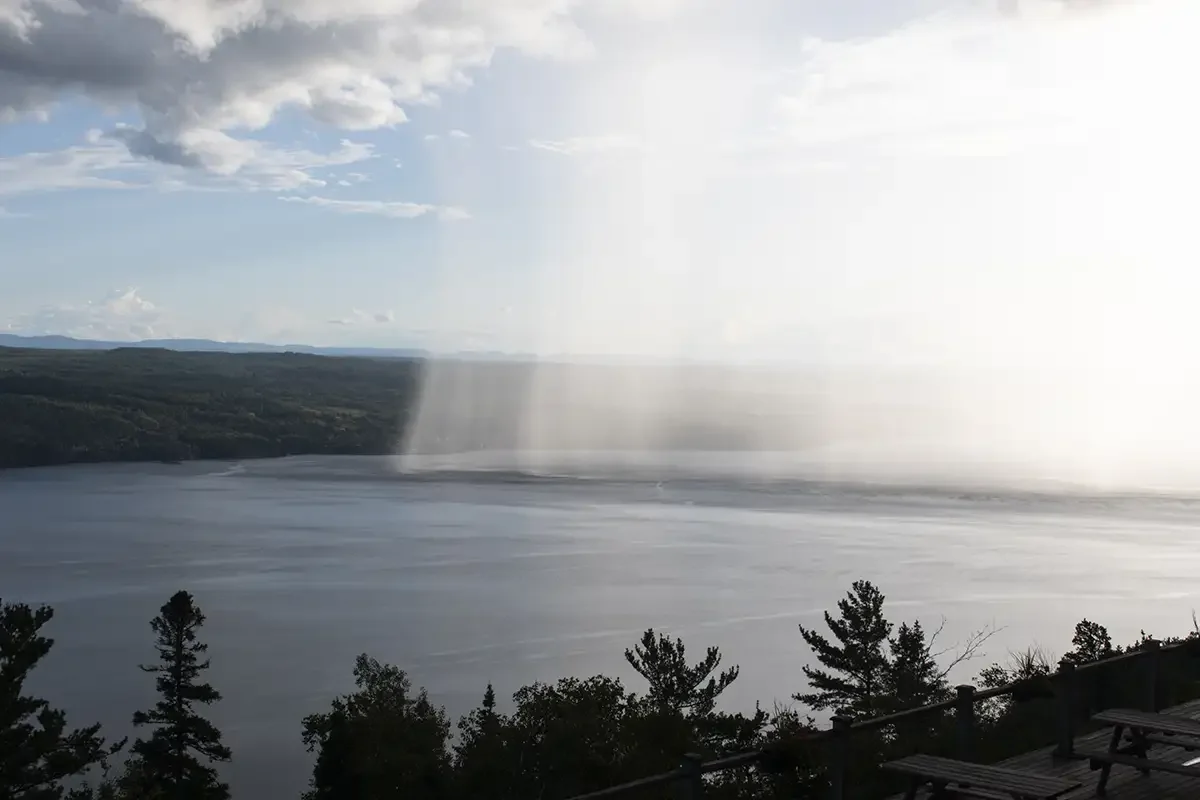
ABOVE: Curtain of rain along the Saguenay River.
The Adventure Begins
First, you must traverse forests on a gravel road to get to the Du Cap au Leste Inn perched high above the fjord, but rest assured, it’s worth it. Rustic rooms have long balconies with superb views of the Saguenay River and its sunsets.
Next, a boat trip from the nearest town, Ste-Rose-du-Nord to Anse-St-Jean, down the majestic Saguenay River fjord, is a must.
Due to the changing rain patterns as described above, you may see rain, winds and sunshine during your boat trip, as you admire the cliffs that make up the south shore of the fjord. Admittedly, I’d tired of the rain and overcast skies, when all of a sudden, the boat’s captain played ‘Ave Maria’ over the public address system. Immediately, the sun came out, and we looked up at the nearby cliffs. At the top of one, now no longer shrouded in mist, was the beloved statue of the Virgin Mary, a well-known landmark by famous Québec sculptor Louis Jobin. Hollywood could not have come up with a better scenario!
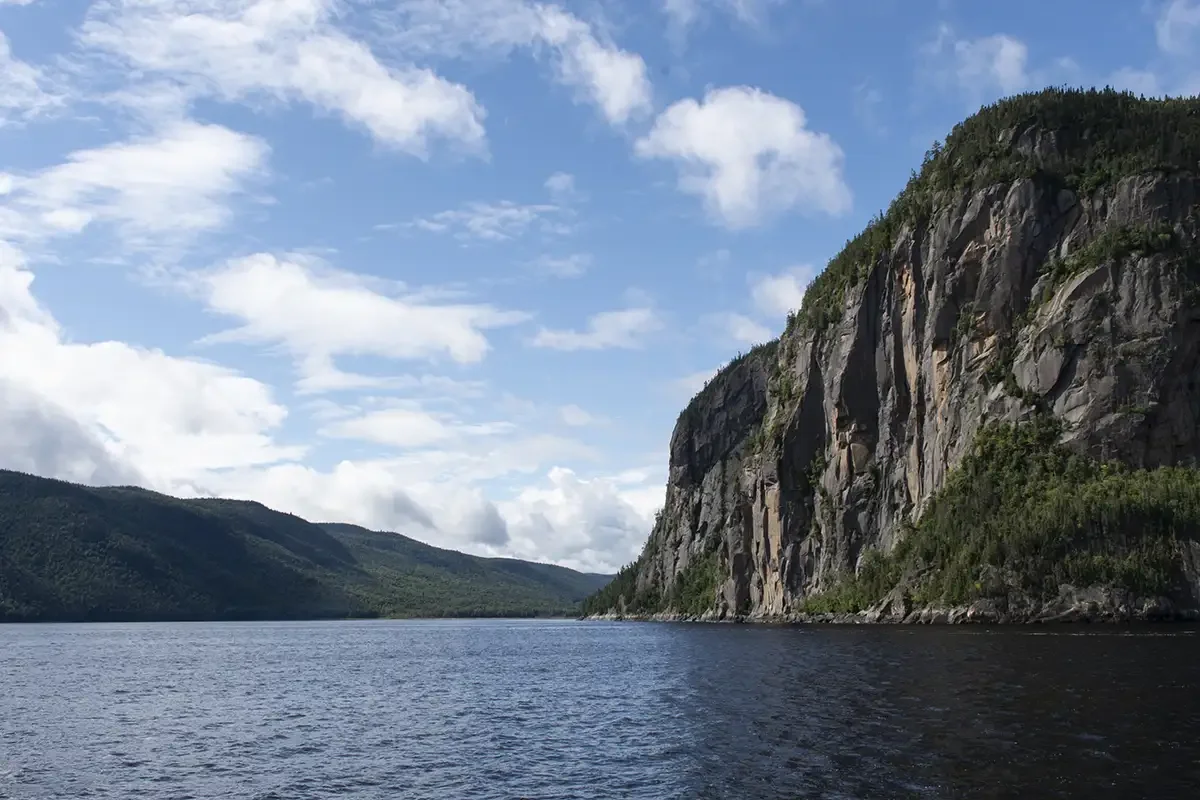
A close-up look at the fjord cliffs on the Saguenay River from the bateau-mouche.
One of the many things to do in Saguenay-Lac-St-Jean is appreciate the abundance of blueberries. Its residents are even known as ‘bleuets’, that is ‘blueberries’.
Undoubtedly, when asked by a ‘bleuet’ what struck me most about his region, my reply was immediate: the people.
Talkative by nature, the people of Saguenay-Lac-St-Jean are not afraid to try new things, love explaining their region and enjoy talking about their respective passions!
In particular, Luc Lamontagne and his wife, Myriam Savard, come to mind.
Things to do in Saguenay–Lac-Saint-Jean
Haskaps Galore at Mistouk Farm
One of the many things to do in Saguenay-Lac-St-Jean is taste the haskaps. Myriam and Luc both left their established careers and bought a piece of farmland at Labrecque, previously used for hay. They upped the ante, choosing to grow and harvest haskaps, although no one in the region had ever grown them before.
Never heard of haskaps? Well, welcome to the club.
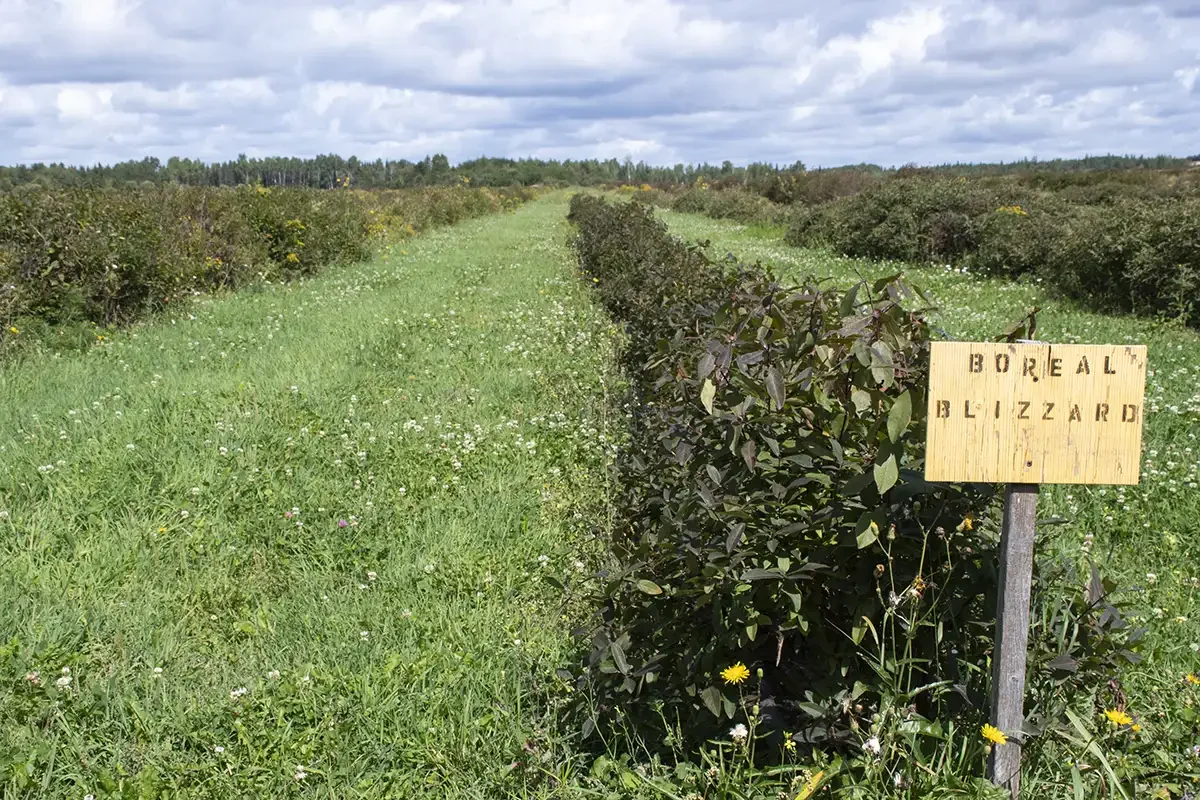
Rows of haskaps.
At first glance, and from a distance, the haskap looks like a blueberry. They have a rich blue exterior with a burgundy interior, look like a bean, and have a sweet and tangy taste.
Introduced to Canada by Dr. Bob Bors, an agriculturalist from Saskatchewan, the haskaps came here via Russia and Japan, where it is known as the ‘Fruit of Longevity’.
The Aurora variety is the most popular in Quebec, and is best suited to the climate and for its use in pies and other delicious delicacies. ‘It is very versatile,’ intones M. Lamontagne. Ever the entrepreneur, Luc has, along with a company in Plessisville, Quebec, invented a machine for harvesting the fruit.
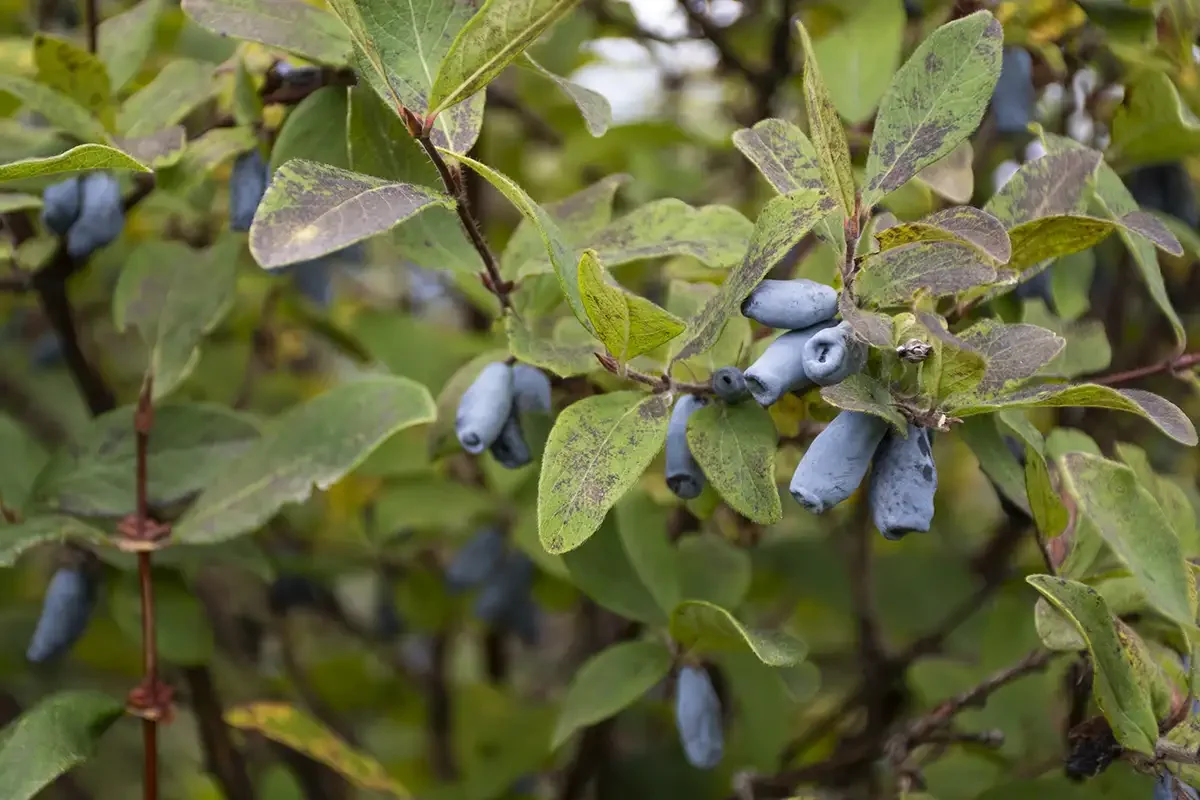
Haskap berries.
In addition, the couple also harvests native spices, which they add to their haskap products, like syrups, tonics and jams. This includes Labrador Tea, Sweet Gale and Dune Pepper, all known to the native population, but only now being slowly reintroduced to mainstream culture as ‘Boreal Spices’.
Next, during our tour of the farm, we stopped in the woods where Luc rummaged through the undergrowth to show us where Labrador Tea grows.
A family affair, the Mistouk Farm is a member of the Economuseums, a worldwide organization, founded in Quebec, whose purpose is to explain farming operations to the general public. Their two grown daughters all have a role in the company, and if need be, other family members pitch in.
Happy Bees, Happy Apples at ‘Api-Pomme’
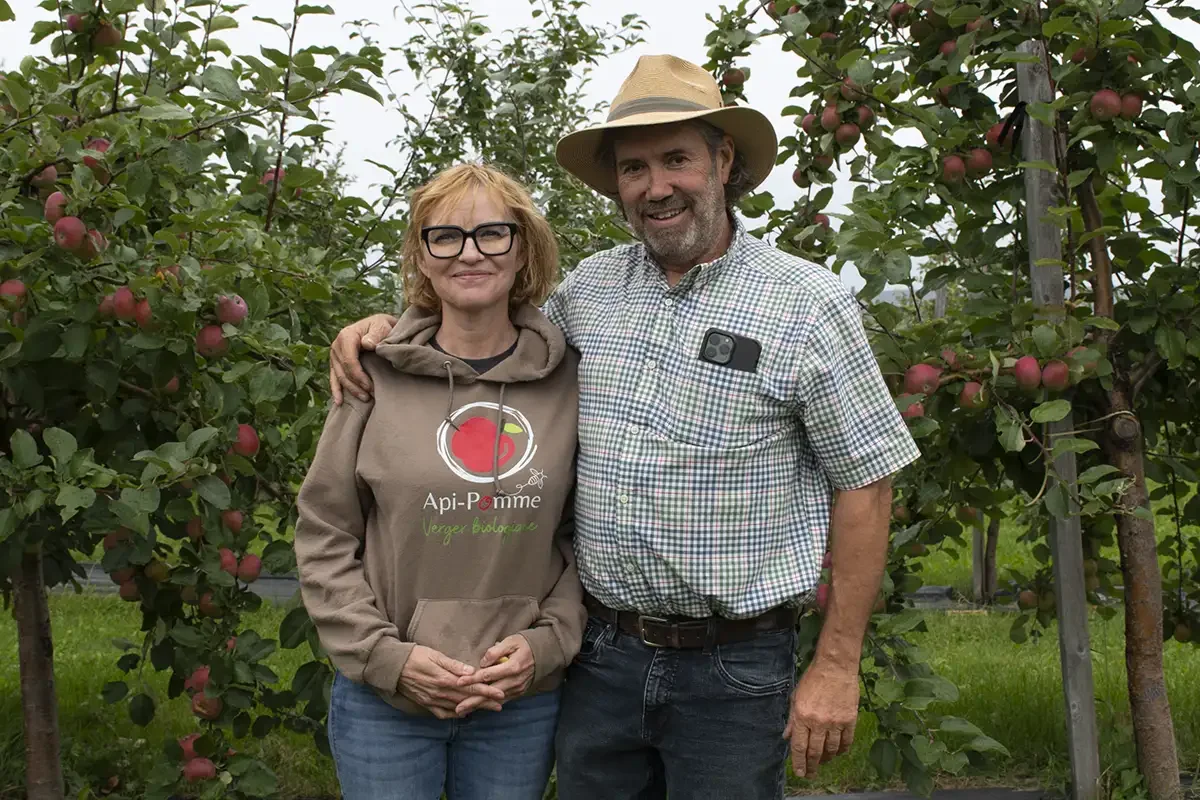
Proud owners of Api-Pomme, Renée & Richard.
An Orchard with a Microclimate
Likewise, Richard Gaudreault and Renée Chamberland of Métabetchouan-Lac-à-la-Croix, followed a similar pattern.
They retired early and, in 2018, bought a piece of land to grow organic apples.
However, they knew nothing about growing apples and the land they acquired had never been used for apples. Indeed, the area had never seen apple orchards.
Renée and Richard realized the land was located in a micro-climate right off the huge Lac St. Jean. The land drained perfectly, and they added berms of soil to protect their orchard from southerly and westerly winds.
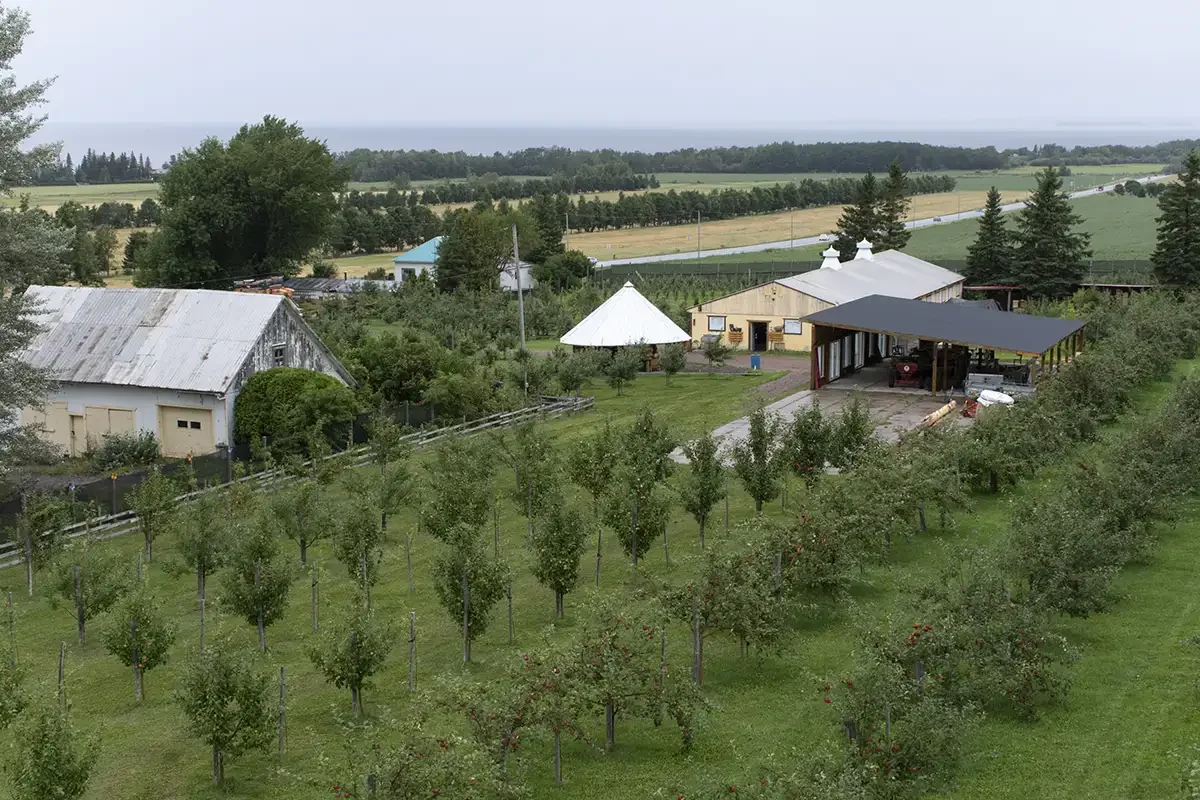
Api-Pomme orchard with Lac St-Jean in the background.
Api-Pomme’s Bistro & RV Camping
Apples at Api-Pomme are pesticide-free and are pollinated by local bees that winter at the orchard. (The ‘Api’ comes from the French, ‘apiculture’ or beekeeping, in English.) It was their interest in preserving the bee population that led the couple to start their enterprise.
In addition, their bistro offers delicious waffles made from locally sourced wheat and topped with their organic apples and is one of many things to do in Saguenay-Lac-St-Jean.
Also, they open their property to picnickers during the day and allow travellers in self-contained RVs to camp for free, as part of the ‘Terego’ programme, popular in farm properties across Canada.
Bringing Coal to Newcastle – Version Québécoise in Saguenay–Lac-Saint-Jean
Next, just down the highway from Api-Pomme in the town of St-Prime, is the Fromagerie Perron, a success for over one hundred years, and one of the most memorable things to do in Saguenay-Lac-St-Jean.
As early as the turn of the previous century, Perron made its name exporting its cheddar to the home of cheddar, in Cheddar, England.
Still considered by Quebec residents as a luxury item in the early 1900s, Perron’s cheese was valued by British connoisseurs, who cherished the hard cheddar wrapped in thin cloth with the inscription ‘Canada’ stencilled on. Indeed, 95 percent of their cheese was exported to England over a century ago.
Today, it is available across Quebec.
And who knows? Perhaps Api-Pomme and Mistouks will one day enjoy the same notoriety as their cheese-making neighbours.
Places to eat in Saguenay–Lac-Saint-Jean
Rabaska — Auberge du Cap au Lese, 551 Chemin du Cap au Leste, Ste-Rose-du-Nord.
Restaurant du Moulin — supper overlooking the Ouiatchouan Falls in the ghost town of Val-Jalbert.
Bistro Boulet Blanc — located at Chalets et Spa Lac St-jean, 109 chemin du Parc-Municipal, Chambord.
Where to stay in Saguenay–Lac-Saint-Jean
Chalets et Spa Lac St-Jean — 109 Chemin du Parc-Municipal, Chambord.
Auberge du Cap au Leste — 551 Chemin du Cap au Leste, Ste-Rose-du-Nord.
Val Jalbert — Haunted buildings, spend a night in the phantom buildings and have an excellent meal next to the falls.
Want to learn more about the endless things to do in Saguenay–Lac-Saint-Jean? Check out this article.
All photos by Carole Jobin