A Bequia Summer: Discovering the Charm of St. Vincent & the Grenadines’ Largest Island
A family trip to the beautiful island of Bequia has left us with memories we won’t soon forget.
The Summer of Bequia
My story about time spent in Bequia begins in St. Vincent and the taxi ride from Argyle International Airport to the island’s ferry terminal. My earliest impressions of St. Vincent are formed on this ride. In my head, those first impressions inspire a name: the island of winding roads and steep hills, I call St. Vincent. Not the catchiest of epithets, I concede, and so one that I keep to myself, more or less. Still, I like to think it captures some geographical essence of this green, lush and mountainous Eastern Caribbean island located in the Caribbean Sea west of Barbados and north of Grenada.
Indeed, much of the highway on which we’re driving is a series of ascents and descents, with often sharp twists and turns. The island’s beaches are below, largely hidden from view, accessed by steep and sometimes winding roads or driveways. Above are similarly steep roads and driveways that lead up into the mountains and the colourful homes located therein, some worn and in need of repair, others grand and stunning. One will drive past roadside bars, fresh produce vendors and the occasional stray dog, all of whom have an uncanny ability to keep clear of the vehicles rushing by. After not too long a drive, one gets to downtown Kingstown, the island and country’s capital. There is a busyness typical of a capital city. Drivers necessarily have to slow down. At one especially busy intersection, police officers direct traffic. People are walking in and out of stores or to and from work.
Here is where you will find the city’s biggest and busiest produce markets, where inland farmers sell the fruits and vegetables of their labour. The city core features other crucial landmarks. The courthouse, parliament buildings and police station. There are old, historic churches. So many vital institutions in so concentrated a space gives rise to the sort of energy unique to cities.
St. Vincent’s ferry terminal is located just beyond the city core and is a crucial hub of activity for the obvious reason: St. Vincent & the Grenadines comprises thirty-two islands, all of which are relatively small. Getting to and from islands thus requires travelling via ferry. After St Vincent — referred to as the ‘mainland’ — Bequia is the biggest among the Grenadines. Until recently, the ferries moved at a single speed, more or less, which meant it would take approximately an hour to get from the mainland to Bequia. In the past year or so, however, the government has introduced a second, quicker option. The ‘fast ferry,’ as it’s called, travels the same distance in about 35 minutes. The time saved is especially appreciated by citizens who travel back and forth between islands, often for work or, if you’re a younger person, for school. For a tourist, either ferry ride is just fine. A half hour is convenient, to be sure, but an hour at sea is hardly draining or time-consuming.
On this day I caught the fast ferry. Moments after settling in, we set sail. The island’s buildings, homes and then the island itself recede from view as the ferry exits the relative calm of the harbour. Soon we enter choppier waters. The ferry sometimes sways as it powers through the swells. A sailboat or two might be visible in the distance. It’s warm, of course, but the sea breeze counters the heat. Birds follow the big boat in their midst, as though playing or showing off to the ship’s passengers. They swoon towards the ship and then glide alongside it before darting up into the sky. Just as one starts to get used to moving through the open sea, land is visible in the distance. Soon the dark blue water of the deep sea turns shallower and clearer, so clear that long before the ship docks the eager traveller can peer over the railings and gaze at the sea floor.
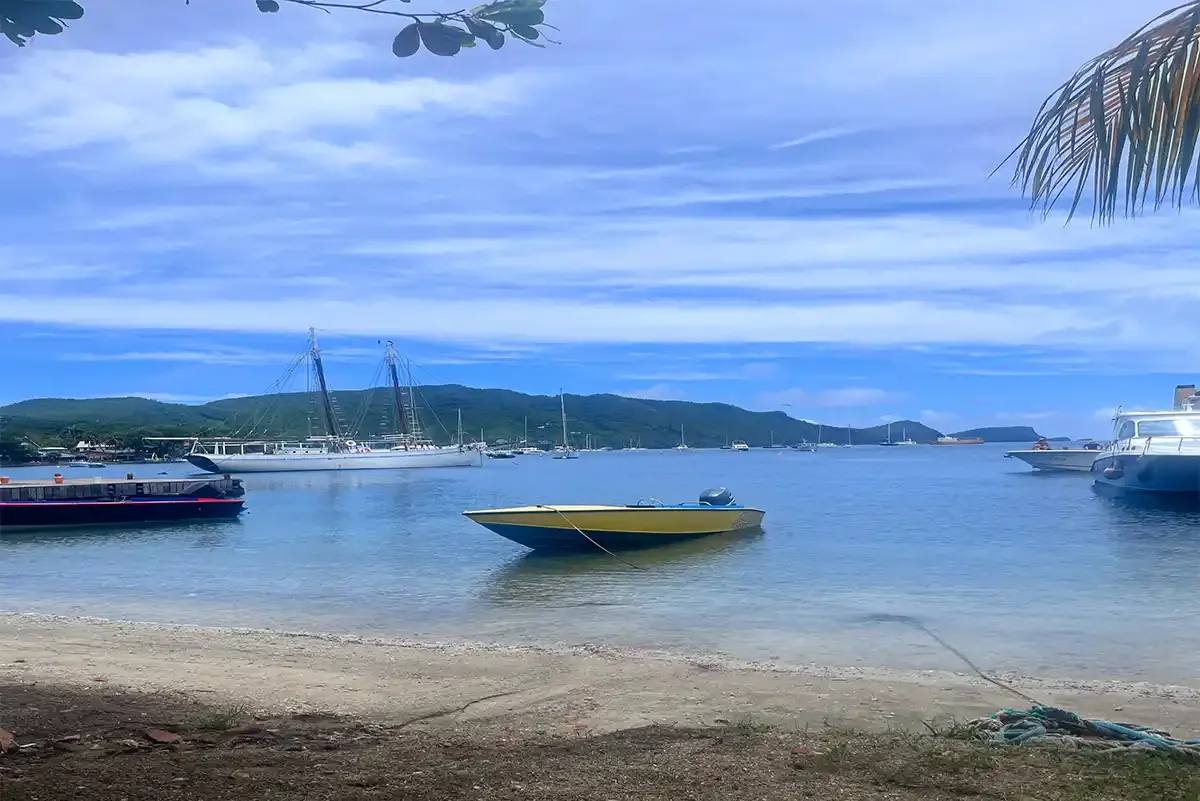
For a child or a first-time visitor, the experience is bound to induce a sense of wonder. One’s gaze will eventually shift upwards, away from the sea floor and towards the island itself. Homes, many brightly coloured, are embedded in the island’s hills, some so high that they seem to sit atop the mountain. Boats of various sizes and expense dot the Bay. Look at the flags that sit atop such boats, and one will immediately get a sense that the island has an appeal that spreads far and wide. I have seen the French flag, a Canadian flag and a Scottish flag, among others. Yet the island’s apparent international appeal can sometimes seem paradoxical. For Bequia can also seem to fly under the radar of many people, even those who love to travel. When I tell friends and relatives from St. Vincent and the Grenadines and of Bequia in particular, they frequently pause and then admit to not having heard of either this beautiful country or island. “Where is Bequia?” I’m often asked.
The ferry moves slowly through Admiralty Bay’s seemingly preternaturally calm waters. The docking process is quick and efficient. Before long, one has disembarked and stepped onto a space busy with people and vehicles. Taxi drivers call out to me, asking if I need a ride. No thanks, I tell them, I already have one. I scan the area and see Noel, the taxi driver I know from a previous visit, with whom arrangements were made to pick me up. We greet each other like old friends before he places my luggage in the back of his beige Nissan pickup truck. We set off. The drive through Bequia’s downtown takes no more than a minute or two, and then we are driving uphill on the winding road that takes me to where I will be staying. Like most drives in Bequia, it is short.
I travelled to Bequia on my own but went to meet members of the family, beginning with my wife Nadia and daughter Brooke and mother-in-law June. There were more, many more: my sister and brothers-in-law — Amanda and Patrick — and their five-year-old identical twin girls, the delightfully and equally irrepressible Zadie and Olivia. Later, our son Joshua would join us, along with my own sister Carolyn, niece Megan, and her three-year-old daughter Charlotte. For a few days, Nadia and Amanda’s cousin Aneika, her husband Kyle, and their young son Myles joined us on the island. Other cousins — sisters Carlene and Sharon — live on Bequia. There were so many of us that at some point as we all gathered it occurred to me: this is a multi-generational family vacation for the ages.
The hope is that for the kids this will be a summer to remember because part of it was spent in Bequia. The summer of Bequia, I sometimes imagine them calling it when they’re older and perhaps start to wonder where all the time has gone. They might recall the weeks spent on the island with a mix of wistfulness and happiness. The long afternoons spent swimming under a hot sun. Collecting seashells and rocks as smooth as silk from the sea floor. Watching schools of fish as they swim past your feet. Jumping off a pier into the sea, swimming back to shore and then asking permission to do it again and again. Swinging together on a giant swing.
They will remember at least some of the islanders they were privileged to meet, including the aforementioned Noel, the kind and patient man with the gentle smile who would drive us here and there, no matter what time of day, all of us sitting on the benches in the back of his pickup truck. Each ride a short-lived adventure. They will think of Doylie, the tall woman with a bright smile and boundless energy who babysat them on a few occasions so the adults could have a night out on their own. They may not recall the ease and grace with which she worked, but they will remember the thrill of a face-painting artist painting their faces at a community BBQ on a hot Saturday afternoon. In their mind’s eye, they will see their grandmother sitting on the trunk of a fallen tree, content to watch from this shady spot as her family swam in the sea.
They might also see June leaping out of her chair on those late afternoons when the sound of a horn would signal the arrival of the bread truck. With a sudden spring in her step, she would run outside and moments later return with a loaf of fresh bread or coconut or cinnamon buns or, her favourite, red belly. Images might spring to mind of Amanda on most mornings carefully measuring both the coffee and the water to ensure the best cup possible for all the adults in the room. Joshua and Brooke will recall the late night when not one but two geckos — in quick succession no less — fell from the ceiling, landing on the floor right next to where they were sitting. Their shared reaction a mix of sudden, but momentary horror followed by peals of laughter.
If everyone’s memories are especially sharp, they will recall the warm night Patrick was the DJ for Nadia’s birthday party and how, midway through the evening, he used his booming voice to call on the partygoers to start to dance and how most people complied as though it was an order. Zadie, Olivia, Myles — and perhaps even Charlotte, too — will remember how they looked up to Brooke, their slightly older and bigger cousin. Although the intense heat of a typical Bequia summer day may be etched into their brains, they may have faint or no recollection at all of the restlessness of a Bequia sky; of how clouds would form in the distance and then settle over the island or rush past overhead, sometimes precipitating a brief but welcome shower, sometimes not. Ahhh, but they may recall the one exception we experienced to this general rule of intermittent rainfall: a lengthy Sunday morning storm with raindrops as big as gummy bears and lightning flashes across a dark, cloud-covered sky and claps of thunder loud enough to make you jump out of your skin and run for cover.
Recovering A Lost Art
Our trip to Bequia was inspired by another purpose. Nadia, my enterprising wife, was teaching a workshop on the not quite forgotten art of batiking. The roots of batik can be traced back to both Indonesia and Africa. It is best understood as a traditional way of creating intricate, colourful and original designs and patterns on fabric. Typically, the fabric is then transformed into articles of clothing, such as dresses, shirts and hats, or accessories. (Think napkins, for example.) It’s a time-consuming process requiring the use of hot wax and boiling water. A labour of love, to put it in more favourable and less daunting terms. Months ago, Nadia reached out to The Hub Collective, an island-based co-operative that engages in various outreach programs. Art is one of the platforms with which they engage those living on the island, the young people in particular. Would the Hub be interested in hosting a Batik workshop that she would give? Nadia asked. The response was more or less instant and wholly enthusiastic. Yes, yes, they would!
That one bit of outreach was the basis for a partnership that was already thriving before I arrived. Indeed, it would grow to include Nadia’s sister Amanda, who led a well-attended one-day workshop on “Healthy Youth Relationships.” As for Nadia, she led a multi-day workshop that included six islanders, all but one of whom were already artists and designers in their own right. Cass is a seamstress and designer with a studio located in the same building as where the Hub operates. Rhonelle and Kay-Marie are designers who, we would learn, work diligently to develop their respective brands. Solana operates a boutique on the island. The one exception was Dravin, a young electrician and musician who resolved to challenge himself by learning something new.
The partnership was ideal for various reasons, one of which was the Hub’s location. It’s situated in a courtyard behind both an Anglican Church and a clothing store in the heart of Bequia’s small downtown. My first visit to the Hub studio was on a typically hot afternoon. Amanda and I were there to meet with Nadia and Colin, the last of the six doing the batik workshop. When we arrived, they were with the aforementioned Cass in her seamstress studio. Colin was wearing a shirt he designed using his recently acquired batik skills but that Cass ultimately made. He was thrilled with the fit and the look.
“I feel like a king,” he says, beaming.
Minutes later, Nadia and I walked up the stairs to the Hub’s studio. The locked doors are protected by an iron gate. Nadia unlocks the gate and then the door. Shoes must be off when walking inside, I am told, so off they go. Colin joins us moments later. Nadia tells me that Colin is both a musician and a painter before showing me one of his paintings. It depicts a full moon partially shrouded by clouds. Stars dot the black night sky. It strikes me as an accomplished piece of work.
“Have you always lived in Bequia?” I ask.
Colin explains that he went to Ontario’s University of Windsor for an undergraduate degree and lived in England for a short time but has otherwise been on the island. This is home. Islanders have to work hard and be entrepreneurial. There’s only so many jobs in places like the post office, he went on to say. So you think of other things to do. You must. That’s why islanders are so creative. Nadia, I plainly see, is in her element in this studio. She’s happy and comfortable, at ease. She and Colin talk about the art of batiking with a quiet fervour. Nadia says helping to restore the art’s place on the island is all about recovering ancestral knowledge. It’s akin to reviving a nearly lost language: there is an intrinsic value that is impossible to measure but nonetheless worthy of pursuing. Indeed, learning to batik has restorative power for both individuals and the wider community. Perhaps this is why the hard work involved has come easily to her, Colin, Cass, and everyone else who has taken part in the workshop. That’s why there’s joy in the process, too.
That same sort of joy was on full display later in our stay, at a ceremony celebrating how far and how quickly everyone in the batik workshop had come. Nadia presented Certificates of Completion to each of the six students. People from the community gathered inside the Hub Collective’s studio to witness the happy ceremony and listen to conversations about batik and how this new and unexpected partnership came to be. Each graduate was wearing an article of clothing they created using batik methods. Each spoke to the audience of the inspiration for their design. A large table on one side of the studio displayed samples of everyone’s work, a mosaic of design and colour.
No one was in a hurry to leave after the formal ceremony and conversations were finished. Why leave when homemade banana bread and drinks were being served? People lingered around the display table, often marvelling at the designs and the craftsmanship. Orders were placed. Towards the end of the afternoon, as twilight was settling in, I was standing and talking with someone at the top of the stairs, just outside the Hub’s entrance. We looked down on the courtyard. All but two of the graduates were beyond their school years. Yet standing together on the green grass, with their certificates in hand and all of them laughing and smiling as they posed for pictures, they looked like university graduates, proud of their shared accomplishment and thrilled at the prospect of what comes next.
Beach Life
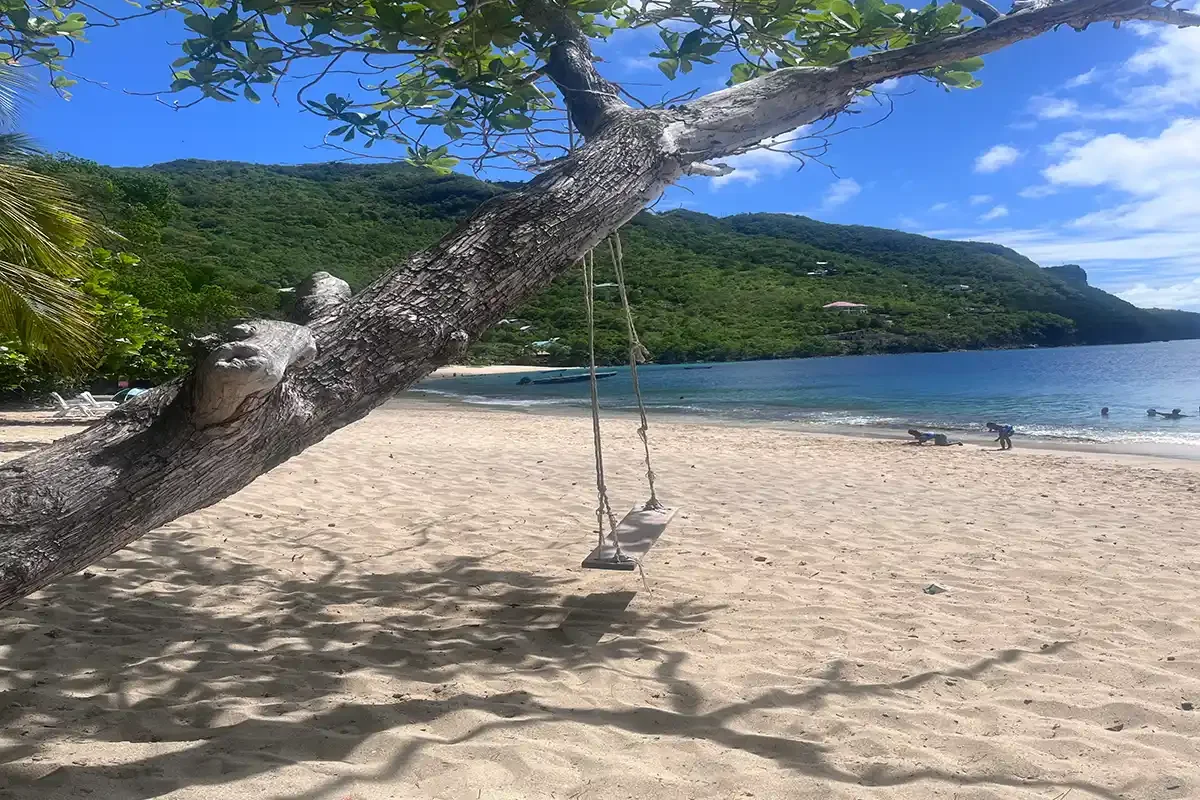
Nature has created the ideal beaches on Bequia. These are not beaches characterized by awe-inspiring waves crashing onto the shore. Instead, Bequia’s sheltered bays have the effect of keeping the water calm. Nor do they stretch endlessly into the distance. Rather, the island’s geography has served to establish smaller, more contained beaches. Trees provide natural sources of shade and enclosure. The combined effect of these attributes is not only to create beaches ideal for swimming. There is also a sense of neighbourliness that is not so easily experienced on beaches elsewhere. Indeed, Bequia’s beaches seem like a natural extension of the various neighbourhoods of which they are a part. This is one reason why, perhaps, they are largely free of flashy trappings. Moreover, they are all public, which means that on any given day, a beach is populated by both locals and tourists. Nevertheless, they are rarely crowded, another reason Bequia often seems like an undiscovered gem. Here is another: the water is shallow for long enough that children can go well into the sea without fear of it being too deep. When travelling with kids too young to swim or to wade into deep water, this is more than just a welcome feature. It’s the difference between a beach day spent playing in the sand and one spent in the water. There was no doubt about what kind of experience the kids and the rest of us preferred. The only time spent in the sand was while walking across it to reach the sea.
Princess Margaret Beach and Lower Bay are the two beaches we became most familiar with. Despite all they share in common, each beach feels slightly distinctive. Princess Margaret Beach, for example, features a pier to which some small boats can be tied but which can also be used as a place to jump or dive into deeper water. It was Brooke who first asked if we could jump off the pier together.
Naturally I agreed. It took a summoning of her resolve to take that initial leap. Three, two, one, we counted down, and then she jumped, knees first, into the water. That started a trend. Indeed, after watching Brooke, Olivia’s curiosity was piqued. Can I try?, she asked. Seemingly indifferent at first, Zadie soon enough was keen to try, too. This was a big step they were taking, one that inspired at least a little bit of fear. The pier was long and relatively high above the water. They were used to frolicking in shallow water. But the water beyond the pier was deep. In the end it hardly mattered. Neither was about to let a little apprehension get in the way of their fun. If Brooke went knees first, the twins went belly first as they jumped towards Patrick, who had been patiently treading water, urging his daughters on. Charlotte would watch from the shallow water with Megan or Carolyn, aware that she was not yet old enough to do something so daring.
Princess Margaret also features Jack’s Bar and Grill, a beautifully designed, spacious restaurant, ideal for lunch or an early dinner. We would swim for hours and then walk up one of two staircases that lead to a brightly coloured, staggered seating area at the centre of which is a bar. The space is covered by large cloth awnings that provide ample shade. The atmosphere is friendly and relaxed. More than once in the afternoon we settled in, the combination of cold drinks, shade and excellent food a welcome respite from the summer heat. The space is so inviting and comfortable and so consistently busy that it made me worry about the fate of Fay’s Bar, located in the middle of Princess Margaret Beach, not far at all from Jack’s. Fay sells beer, juice, and soft drinks, but there is nowhere to sit unless one rents a lounge chair.
Lower Bay Beach was our other favourite haunt. We would arrive late morning or early afternoon. A strict protocol was assiduously followed. We would gather underneath a tree and lather ourselves in sunscreen. After fifteen minutes, the kids and at least one or two adults would then run across the often hot sand into the water. So would begin our day in the sea. There is no pier at Lower Bay, but the beach does feature an oversized swing tied with a long rope to a fortuitously located branch on a tall tree. Sitting on the swing with at least one or two others feels like a rite of passage: every child who swims at Lower Bay will want the experience. The beach also has, among other places, Gracie’s Bar and Restaurant (formerly Keegan’s; the name was changed in the last year). It feels more like a Bequia institution as compared to the new and slightly more upscale Jack’s. The place’s design is more basic but no less comfortable. There are three oversized, swinging chairs at the bar, perfectly suited to a place in the sun. Go there at any time of day and watch as people sit on those swinging chairs, a beer or daiquiri in hand, and chat with either a friend or one of the friendly staff. Here too the atmosphere is invariably chill.
Night follows day, and the kids start to grumble about needing to eat. The adults grumble less but must eat, too. Some nights we prepare our dinners and eat in; other nights we eat out. For a relatively small island, there are many fine restaurants to choose from. Many, although certainly not all, of the island’s best restaurants look out on the harbour. They have this in common. Yet like the island’s beaches, they are distinctive in some aspects of their design and, of course, their cuisine. Mac’s Pizza has two levels of seating. Its dark stonework and dark wood tables, combined with its dim lighting, serve to create an intimate atmosphere. Most kids love pizza, and so, of course, families gather here to dine. We ate there on one of our last nights before having to depart for home. It was still warm when we were seated at a table on the restaurant’s upper level. Just as Nadia and Amanda mentioned the heat and the need for a cold glass of water, a breeze blew in from the harbour. It was as though a happy equilibrium was restored. The breeze passed, but the heat no longer seemed so intense. The Plantation is more open and spacious. Its predominantly white decor and string lighting give it a brighter feel at night. The harbour is more visible, less shrouded in darkness. The Fig Tree stands out less for the restaurant’s design and more for the host’s gracious and welcoming disposition.
She’s the sort of host who approaches each table to ask patrons if everything is to their liking. The night we dined there, the kids were happy at first but then grew restless. She immediately sensed we could use a hand. “Come with me,” she told them, and so off they went to another part of the restaurant. With an ever-present wide smile, she made sure the kids were happy, well fed and entertained.
The simple truth is that the dining experience at any of these fine restaurants — as well as others — will be a pleasurable one.
Vantage Points
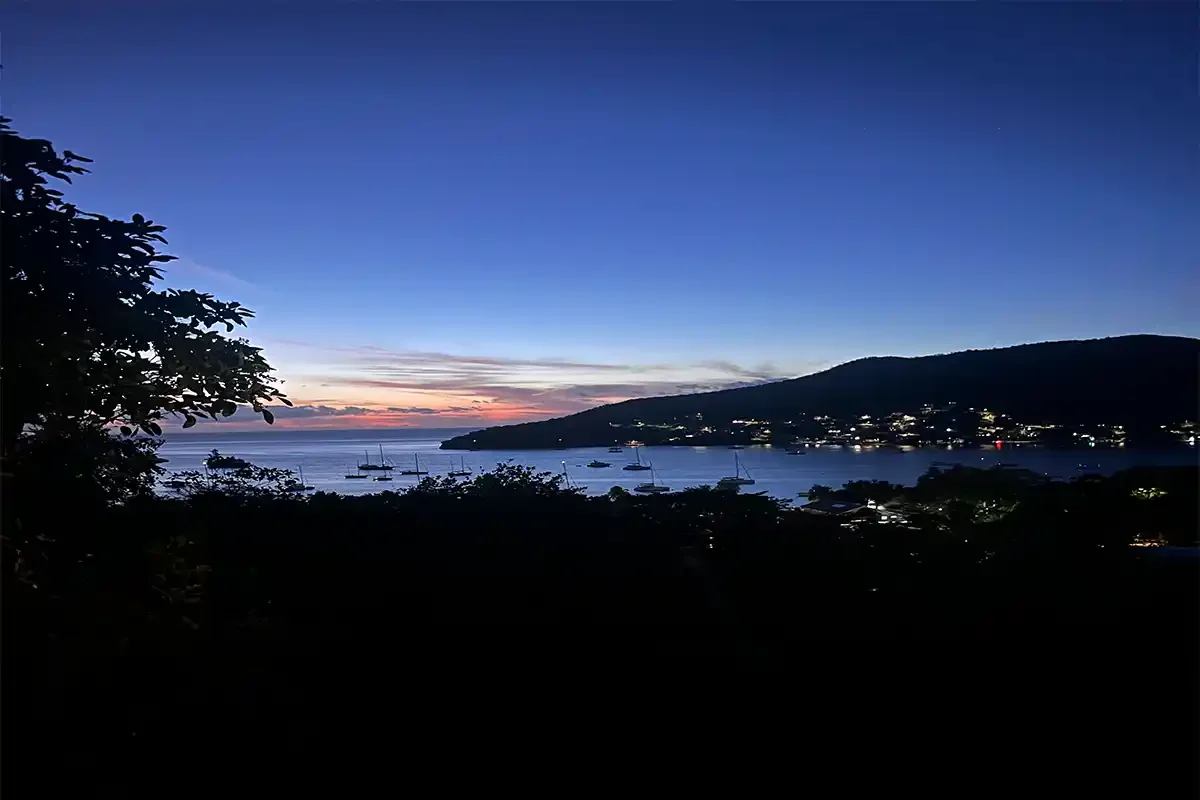
There were moments during our stay when I found myself in a reflective frame of mind. I would consider, for example, the different impressions the same Bay can stimulate, depending on one’s vantage point. When we looked at Admiralty Bay from the verandah where we stayed, it would appear mostly still. Occasionally, we would watch a boat move through the water. There were also the last ferries of the day coming and going. Yet the overall impression was one of stillness. Most boats sat motionless in the harbour. The sea appeared as it might in a painting, quiescent and deep blue. It would retain this appearance of stillness even at dusk, as the sun set and night started to fall. On many such twilights, a brilliant mix of red and pink clouds resembling distant mountain ranges were etched against the sky.
The same harbour generates different impressions when spending time much closer to it. There were mornings when we would wake up, dress and, before the heat settled over the island, walk down towards sea level. Other mornings I walked alone. Eventually I would find myself walking on the island’s concrete boardwalk that followed the contours of the bay. Crabs scurry across before slipping into the shallow water. The odd stray dog would greet me as a neighbour might, never threatening, always friendly. Each morning I did this walk, I would pass an elderly gentleman sitting in the same chair at the same establishment he either frequented or, who knows, owns. One of his legs would always be pressing against a pole opposite his chair. Two stray cats would be curled up and asleep next to the chair legs. His presence must be reassuring to them, I thought to myself. He was always reading a book but would look up as I passed.
“Good morning”, I would say.
“Good morning”, he would reply. It was the simplest of exchanges, but his greeting always struck me as warm and sincere.
Whether alone or with others, the destination was always Sugar and Spice Cafe, one of the few such cafes on the island. I would order my coffee and sit outside at a table facing the harbour. (If coffee is not your thing, I would recommend the Crazy Coconut smoothie: cold, smooth and delicious.) The harbour is not so still or quiet when sitting so close to it. On the contrary, the sea gently swells. The smell of the sea fills the air. The sounds of birds fill the silence. The same birds glide, swoon, and dive headfirst into the water, often emerging with a fish in their beaks. The sea’s ceaseless movement feeds into a larger, more expansive impression.
Bequia’s dynamism is more keenly felt from this vantage point: locals walk past on the boardwalk, perhaps on their way to work or out for a morning stroll. Others ride across the water in their motorboats or engine-powered dinghies. There is the sound of the ferry horns announcing a ferry’s arrival or departure, brief but booming, consistent and somehow reassuring. I see others standing atop their catamaran, unravelling knots by the looks of it, readying for a day out at sea. I see the man with bulging biceps kayaking through the bay, as he seems to do every day. Tourists and locals walk to Sugar and Spice for their morning java or smoothie and perhaps breakfast. People gather at the tables, some laughing and talking, others clearly engaged in deeper conversations.
Observing all this activity doesn’t displace the sense of Bequia as an oasis of quiet calm. As a place to unwind. As a place to chill. That is the vibe, of this you can be sure. But it does add another dimension to the experience of being here. Indeed, more than once an idea would dawn on me, as bright and invigorating as a Bequia sunrise. There is so much more still to discover about this island. In its own quiet, unique way, I think Bequia is a beautiful and bustling place, bursting with life.
ALL PHOTOS BY DON MCCLEAN