A Great Unknown in Quebec: Exploring the Farms, Wineries & History of La Montérégie

The Montérégie region of Quebec is considered the province’s pantry. At first blush, it appears to be an endless vista of corn fields, soybeans and orchards. However, after visiting multiple farms and properties, I ended up learning a great deal about the huge number of different products and excellent wines made there. I even picked up some interesting historical tidbits.
Can you imagine doing the back-breaking work of harvesting grapes for free? At the Coteau des Artisans winery in Béthanie, Quebec, this is exactly what happens, at least for a day or two every September.
Truly though, I can see why folks get interested. The winery is located in a beautiful, tiny valley fronting on the Noire River. Co-owner Karine explains that once the dates of the vendanges are announced on Facebook, the spots fill up within hours.
Husband Jocelyn created this piece of paradise from scratch, taking an abandoned farm and literally levelling the angled hills here, before adding soil and then planting grapes.
The wines are processed using amphora jugs like those used in ancient times — we’re talking thousands of years ago.
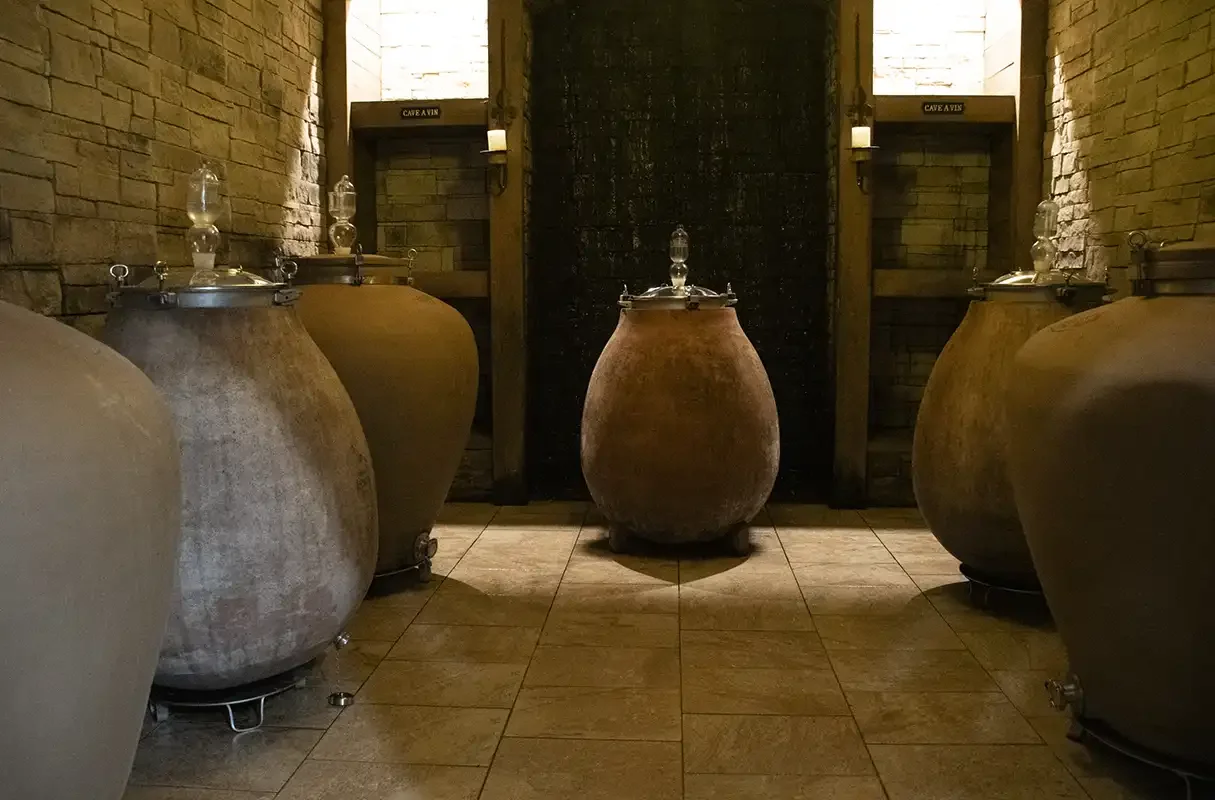

Wine slowly ferments in amphora jugs at Coteau des Artisans, while (RIGHT) at Rabouillère Farm, the welcoming committee awaits visitors.
During our farm agricultural explorations, we stopped at the Rabouillère Farm, where we chatted with Marie-Claude Boucher,
Maybe she inherited her love of farming from her father-in-law, Pierre Pilon, founder of Rabouillère Farm, located in the countryside of Saint-Valérin-de-Milton.
He created one of Quebec’s first country restaurants, the tables champêtres. These tables were pioneers in the land-to-table movement, where products served in the restaurant are either produced on the farm or nearby.
Rabouillère means ‘rabbit burrow’. Not surprisingly, even today, guests can interact with rabbits and other animals. Some are raised for their meat and many of the birds for their eggs. In the henhouse area, there are exotic chickens such as Polonaise, Cochin and Hamburg.
The Montérégie is a vast region. We visited only the eastern part of it, basically following the course of the Richelieu River.
A list of other properties we visited and would recommend includes:
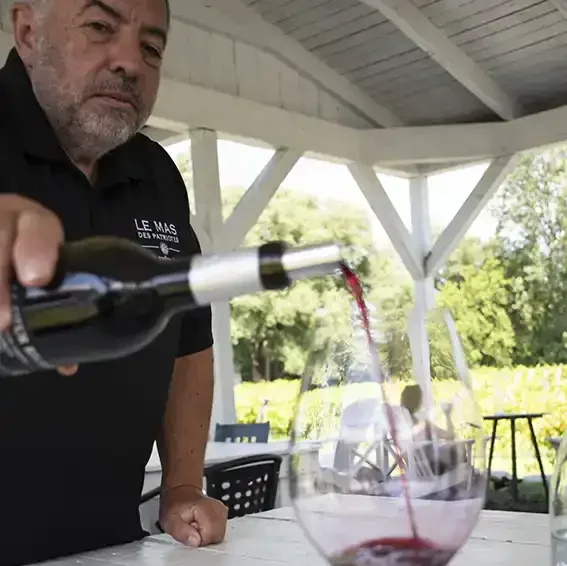


Clockwise from top left: Bruno from Le Mas des Patriotes; a flight of organic beer at Terre à Boire; happy cows at Effet Boeuf; and geese roaming freely at Au Gîte des Oies.
Le Mas des Patriotes, a smallish winery (30,000 bottles produced annually), with many award-winning wines is locally owned. Owner France Cliché and sommelier Bruno explain the combination of hybrid, Nordic and traditional European grape varieties, paired with delicious cheeses from the nearby Fromagerie Missiska. Our visit took place in the vineyard, behind a magnificently restored barn.
The owners of Terre à Boire, a brewery and restaurant, are justifiably proud of their organic beers and spirits produced using their own grains. The atmosphere is a real summer fun one and flights of beer of your choice can be had.
L’Effet Boeuf, in Saint Robert, specializes in Angus and Wagyu beef, and is soon to become an Econo-Museum, meaning it will educate visitors about their farm/ranch techniques. It is also a table champêtre.

Dominic from Les Trouvailles Gourmandes du Canton
At Les Trouvailles Gourmandes du Canton, in Roxton Falls, Chantal and Dominic are behind a family-run farm, bringing in chefs from Montreal to present creative ways of preparing their lamb. One of their newest products is the lamb jerky.
In the same village, Au Gîte des Oies refers to a former B&B on the property, a ‘gîte’ being an inn. But the place is quite literally an inn for geese today. They are very well treated and share space with a collection of exotic birds, whose eggs are for sale. It will soon become an Econo-Musée.
Some of the farms are also Terego, meaning that campers can use their space to set up their trailers at minimal cost.
Some History

Fort Chambly
Along with being an important, little-known agricultural region, the area’s history is of greater significance than some might suspect. The historic sites we visited are on opposite ends of the Richelieu River.
Near St-Jean sur Richelieu is Fort Chambly, a Parks Canada establishment which played an important role in Quebec and Canadian history.
The French Navy built the first wooden Fort Chambly here in 1665 while in conflict with the Iroquois Nation.
The fort played a role during the failed American invasion of 1775, housed a military complex during the War of 1812 and was used for prisoners during the 1837 Lower Canada Rebellion.
Speaking of the 1837 Rebellion, at the Maison Nationale des Patriotes, on the northern part of the Richelieu, an extremely complete exhibit, housed in an ancient inn, explains the Lower Canada Rebellion and the role of Saint-Denis-sur-Richelieu in the conflict.

Maison Nationale des Patriotes
Exhibits include a pistol that once belonged to rebellion leader Louis-Joseph Papineau and the ceinture flechée, today’s well-known symbol of French Canada.
Restaurants
Although most days we were full from tastings at the different farms and wineries, we did enjoy three outstanding meals in the region.
The first was at the Old Mill Restaurant in Stanbridge East, whose claim to fame is the exclusive use of local products, including many vegetables from their own gardens and greenhouses, a commitment to sustainable gastronomy. This earned them a Michelin star.


Located in the Rive Gauche Hotel in Beloeil, Le Coureur des Bois, is not to be missed. Wine pairings were expertly determined by head sommelier Jean-Simon who knows the local wines inside and out, along with international selections.
Part of our outstanding meal included a fresh Halibut à la crème de maïs, and a dessert that my wife described as ‘one of the best she’s ever tasted’. It was paired with an unusual red ice wine, having the taste of port.
After the meal, we had a chance to visit the restaurant’s massive wine cellar with over 17,000 bottles. It has consistently won the Wine Spectator award for best wine cellar in North America.
Other addresses not to be missed in Montérégie.

-Cidrerie Michel Jodin has been producing ciders and brandies since 1999, the orchard has been in operation since 1901.
-Charbonneau Orchards, is a very well-established orchard with a sugar shack, creperie restaurant offering giant crepes and a store packed with goodies. Come with a good appetite! Next door is CIME, a group that allows you to climb Mont-Saint Grégoire, one of the many ‘monts’ or monadnocks, in the Montérégie. I plan to revisit the Montérégie so as to climb many of the mini mountains.
-The Strom Spa at the base of Mont-Saint-Hilaire is a lovely spot with small crowds and an excellent restaurant.
Bring a cooler with freezable ice packs, as you will undoubtedly fill it with meat, cheese and other products. Make sure your GPS is working properly. You will traverse many paved country roads as you wind your way through field after field.
Note to travellers: By all means, bring a cooler with freezable ice packs, as you will undoubtedly fill it with meat, cheese and other products. Make sure your GPS is working properly. You will traverse many paved country roads as you wind your way through field after field.
For more great stories on travel by Bruce Sach within Quebec, read Transported Back in Time to Another World, in Just Under Four Minutes.
All photos by Carole Jobin