
Virginia VA250 Guide: Mount Vernon, Museums, and the Best Ways to Celebrate the 250th
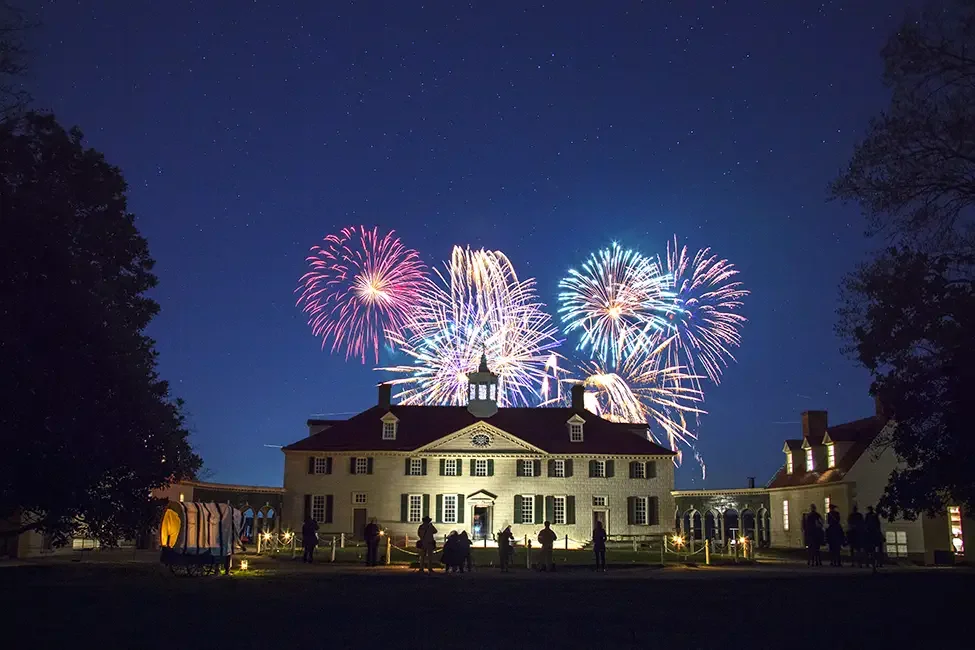
Table of Contents:
Whether you’re a nature lover, beach lover, museum lover, foodie, or even a budget-conscious traveller, Virginia makes an exceptional vacation destination. The state may not be the largest, but it punches well above its weight, especially considering the outsized role it played in the birth of the United States. With the nation preparing to celebrate its 250th anniversary, Virginia’s wealth of museums, historic sites, and outdoor adventures makes it an ideal place to explore.
We kicked off our Virginia journey with a visit to Great Falls Park. Tucked into a residential area along the Potomac River, just 15 miles from Washington, D.C., the 800-acre park is the perfect place to stretch your legs after a travel day, and a great spot for kids to burn off some energy.
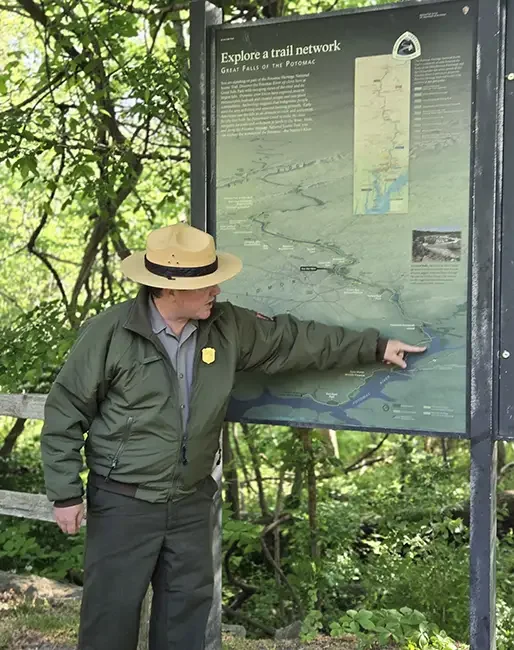
National Park Service Ranger Mark Malloy points to the location of Great Falls and its proximity to Washington, D.C.
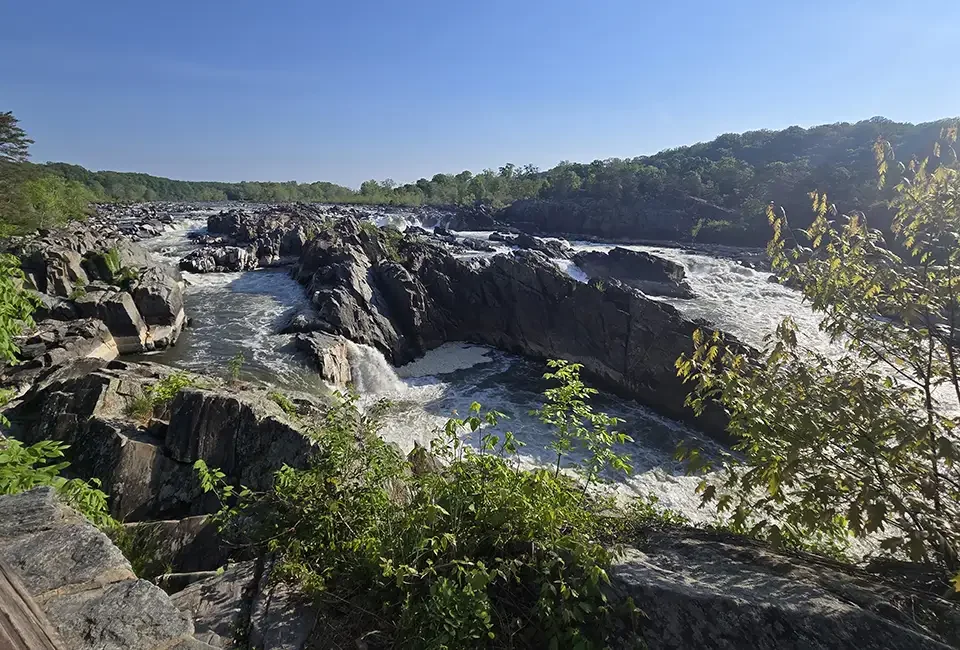
Named for its dramatic waterfall, the park is both beautiful and intimidating. Jagged rocks slice through the rushing water, creating frothy white rapids below. If you’re lucky, you may even spot members of the U.S. National Whitewater Teams training upriver. Swimming and climbing on the falls are prohibited, however, as the currents are simply too dangerous.
National Park Ranger Mark Malloy explained that throughout the colonial period, boats could not navigate past the falls. In 1785, George Washington became a driving force behind the construction of the Potomac Canal. A small town called Matildaville sprang up around the canal locks roughly 15 miles upriver from present-day Washington, D.C. Today, visitors can still explore the ruins of the town, now hidden beneath dense foliage. The archaeological site is intentionally left understated to help preserve its fragile remains.
Matildaville was named by Col. Henry “Light-Horse Harry” Lee after his first wife, Matilda. Lee is perhaps best known today as the father of Confederate General Robert E. Lee, who led the Army of Northern Virginia during the American Civil War (1861–1865).
FUN FACT: Light-Horse Harry Lee famously described George Washington as “First in war, first in peace, and first in the hearts of his countrymen.”
Beyond admiring the falls, hiking the trails, or watching climbers scale the rocks, it’s fascinating to stand in a place where people now come to relax and play, knowing it also played a small but meaningful role in the nation’s early history.
The park is open year-round and hosts scheduled events throughout the year. Before visiting, check the Great Falls website and Facebook page for current programming and updates. Entrance fees are paid electronically by smartphone.
Traveller’s Note: The opposite side of the river also has a park called Great Falls Park. Same falls — different state. Make sure your GPS says “Great Falls, Virginia.”
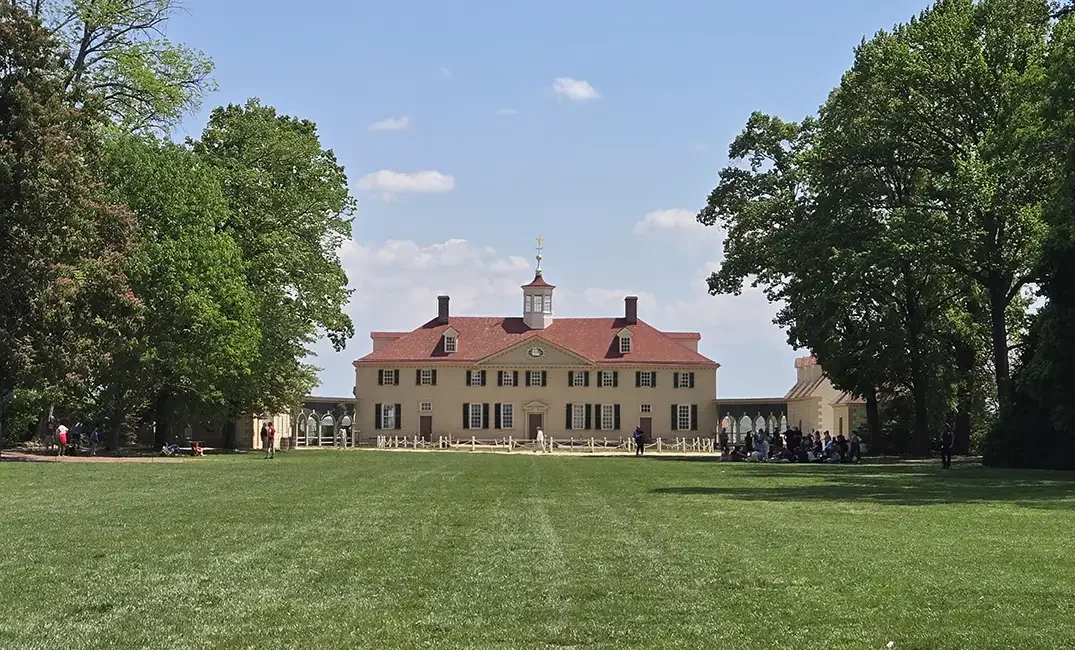
Mount Vernon became an unofficial diplomatic salon during Washington’s presidency, drawing statesmen, generals, and foreign dignitaries whenever he returned home.
The History Continues
Washington, D.C., may be where politicians, lobbyists, and Hill staffers work, but Virginia is where many of them choose to live. One of the most famous homes in the state, and arguably in America, is Mount Vernon, George Washington’s beloved estate.
Located along the scenic George Washington Memorial Parkway in Fairfax County, Mount Vernon is a must-visit whether you’re a snowbird passing through or planning a family trip to the Washington area. Touring the estate offers remarkable insight into the character of a man widely considered the Father of His Country and a defining example of leadership.
Years ago, during a visit to Annapolis, Maryland, I learned what may have been Washington’s greatest act. After winning the Revolutionary War, he rode to Congress, resigned his military commission, and returned home to Mount Vernon to farm. In doing so, he established a foundational democratic principle: civilian control of the military and the peaceful surrender of power.
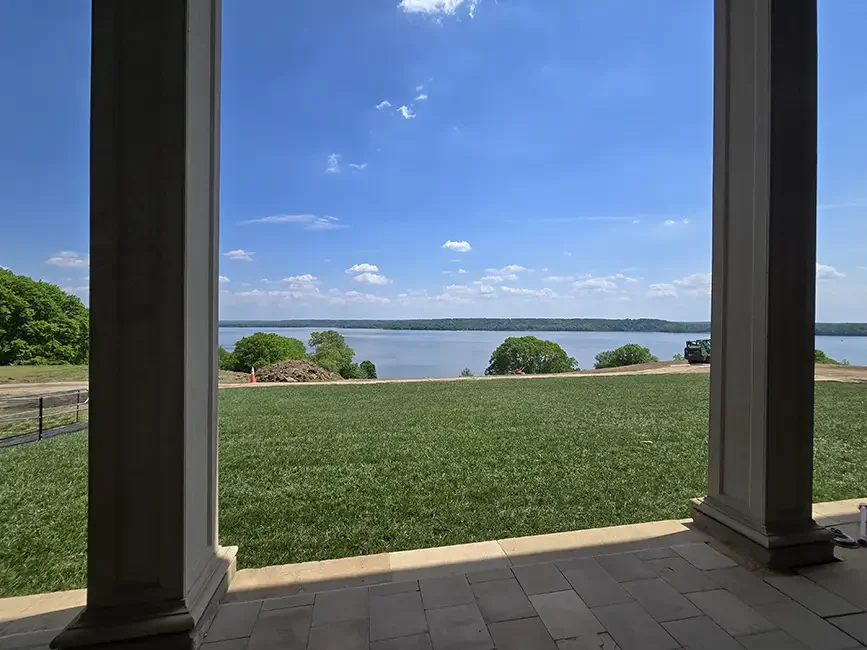
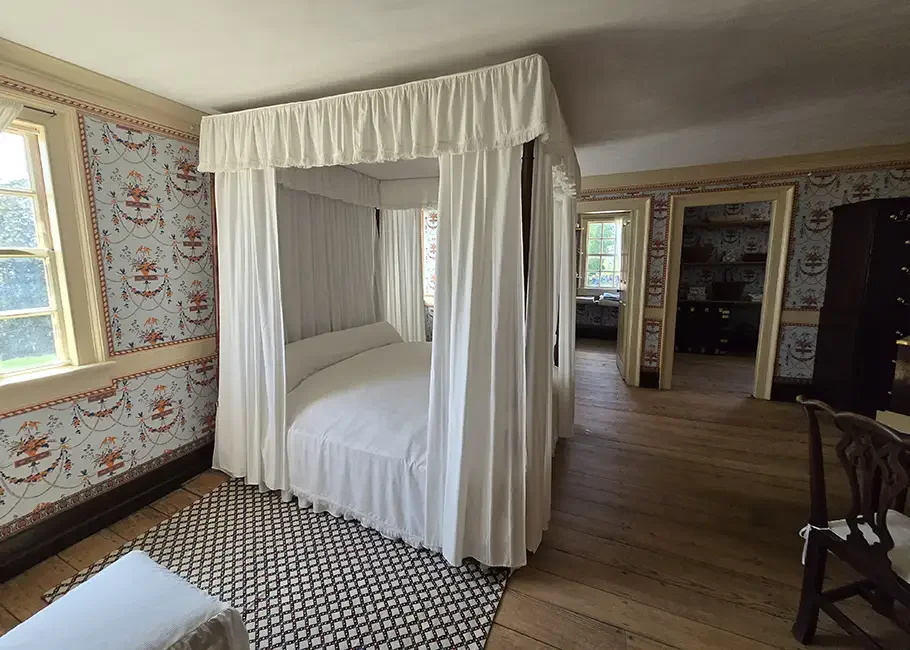
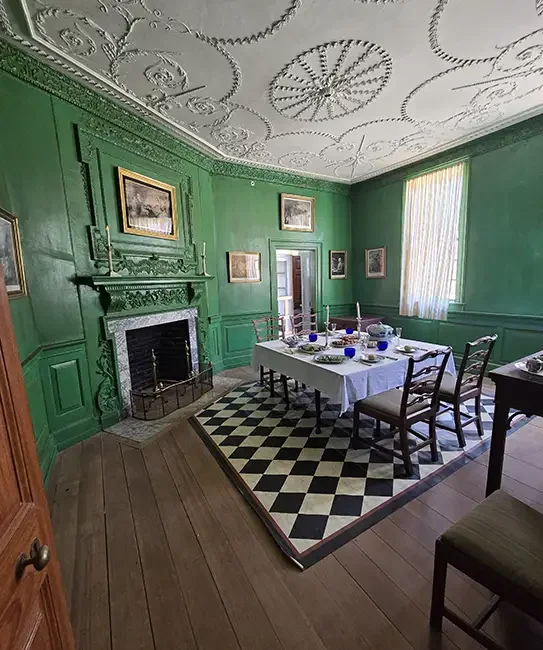
The mansion’s broad east piazza overlooks the Potomac and the (then) Maryland territory on the opposite shore. RIGHT: The master bedroom of George and Martha Washington, where the late president died in 1799.
As preparations continue for the 250th anniversary of the United States, Mount Vernon has undergone extensive renovations, including a newly updated exhibit dedicated to Washington’s life and legacy.
You can easily spend an entire day at Mount Vernon. A charming building on the property, often mistaken at first glance for the mansion itself, houses the on-site restaurant. While there, try two of Washington’s reported favourites: peanut soup and hoecakes served with butter and honey. The soup reflects simple colonial cooking, while the hoecakes are surprisingly delicious.
Mount Vernon attracts more than one million visitors annually. While lines to tour the mansion can be long, there is so much to absorb throughout the estate, thanks to both the visual beauty of the grounds and the interpretive staff who share stories about Washington’s life. The home itself was originally built by Washington’s father in 1734 and inherited by George Washington at age 22.
NOTE: In his will, Washington requested that the enslaved people he owned outright be freed following Martha Washington’s death. His personal valet was freed immediately.
As a military leader, Washington lost more battles than he won, but his perseverance and ability to inspire loyalty among a ragtag militia ultimately led to victory. As the first president, he had no roadmap for governing a new nation, yet his ability to surround himself with capable advisors and influence people proved critical. Perhaps his greatest gift to the country was knowing when to step away — first by resigning his military commission in 1783, then again in 1797 after two presidential terms, establishing a precedent that shaped American democracy for generations.
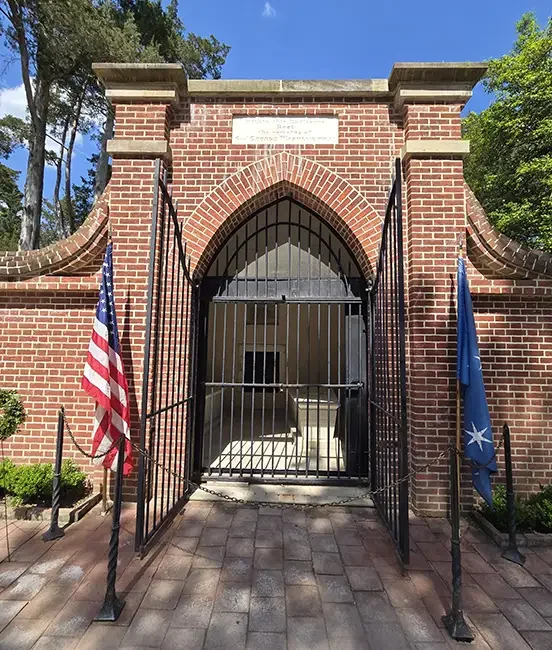
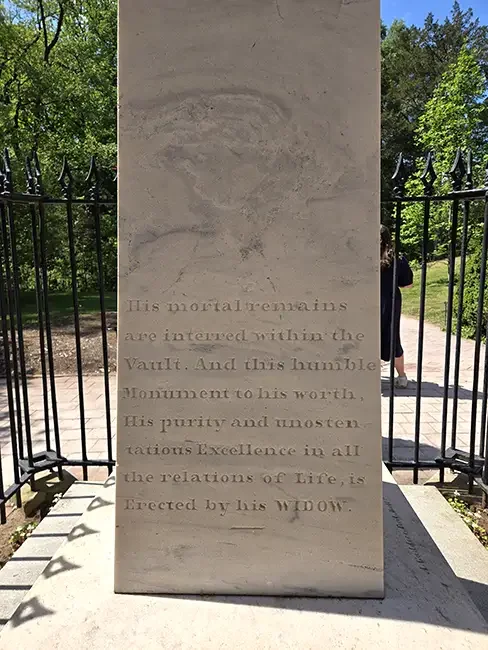
Before leaving, we visited the modest Washington family tomb. Interestingly, the inscription reads “General George Washington.” He reportedly preferred the military title he earned over the presidential title bestowed upon him by the people.
In addition to interpreters dressed in period costume, Mount Vernon hosts living-history encampments during major holidays, where visitors can experience Revolutionary War military life. Kids can even march in formation and pretend to be part of the colonial militia.
A visit to Mount Vernon leaves you inspired to be a better citizen — and perhaps to expect more from the leaders of whichever country you call home.
FUN FACT: In 1858, the newly formed Mount Vernon Ladies Association of the Union purchased the crumbling Mount Vernon mansion and began restoring it with the goal of preserving it as a “Sanctuary from politics and corruption.” They tracked down the former furniture and housewares that had been willed to different family members and repatriated them.
Zero Is What You Pay for Museum Admission
“1775 Liberty Drive” is a fitting address for the National Museum of the United States Army, named for the year the U.S. Army was founded. In fact, aside from the large parking lot, the address itself may be the clearest sign that a museum even exists. Depending on the light, the sleek stainless-steel building almost disappears into its surroundings.
As it turns out, that’s intentional.
The architecture reflects the nature of the Army itself. As a ground force, the Army constantly adapts to changing conditions, and the museum’s exterior does the same. Its polished metallic skin changes appearance depending on the season, weather, and time of day.

To reach the galleries, visitors first move through Soldiers’ Stories, the museum’s quitely powerful entry installation.
Open daily with free admission, the museum, owned and operated by the United States Army, is deeply impressive. Before even entering the building, visitors are greeted by a row of eight-foot-tall stainless-steel pillars etched with portraits and stories of service members.
NOTE: The U.S. Army actually predates the founding of the United States by one year. It celebrated its 250th anniversary last year.
The installation, called Soldiers’ Stories, continues inside the museum, where towering panels stand in silent formation. It’s a powerful and understated introduction that foreshadows the museum’s focus on the personal experiences of those who served.
The exhibits are so engaging that there truly is something for everyone. Even the most reluctant teenager dragged there by their parents will inevitably find something fascinating — though they may never admit it.


CLOCKWISE FROM TOP LEFT: Austere and purposeful, the museum’s architecture channels the discipline and resolve of the U.S. Army (Photo: Hannah Armstrong ©Virginia Tourism Corporation); A special 250th anniversary dynamic augmented‑reality exhibit uses iPads to immerse visitors in key moments from the birth of the nation; The G‑STEM exhibition highlights the technical expertise and problem‑solving skills used daily across Army branches; A remarkably lifelike figure of Sergeant Major William Seymour, a Revolutionary War soldier, writes in his diary — the original of which is preserved in the Library of Congress.
The interactive G-STEM (geography, science, technology, engineering, and mathematics) area demonstrates the skills required for various Army careers and how those technologies apply to everyday life. Visitors can test their abilities through avatar-led simulations. I attempted to build a bridge during one exercise. It collapsed spectacularly, but it reinforced how much emphasis the Army places on training and precision.
The exhibits also highlight how military innovations eventually found their way into civilian life, including weather forecasting systems, rocket technology, medevac helicopters, and even early cellphone technology.
Six additional galleries explore key periods across the Army’s 250-year history. One standout exhibit uses 3D augmented reality to immerse visitors in pivotal moments of the American Revolution, vividly bringing the sights, sounds, and tension of the era to life.
TIP: As part of the 250th anniversary celebrations, many museums and attractions are participating in the VA250 Passport Program. Visitors can collect stamps, receive discounts, and enter prize draws at more than 70 locations across Virginia.
Thankfully, the museum includes an on-site café because you can easily spend a full day there. Upstairs, the special exhibition CALL TO ARMS, celebrating the Army’s 250th anniversary, features 280 artifacts, including 200 on loan from England, France, Canada, and private collections. Many have never before been displayed publicly in the United States.
The exhibition shares the deeply human stories of those who fought for American independence. What becomes increasingly remarkable while visiting Virginia’s historic sites is just how divided and isolated the original colonies often were. The achievement of uniting those colonies — and ultimately defeating the British Empire — feels even more extraordinary in person.
A Day Built on Discovery
The Smithsonian museums located across the river in Washington, D.C. — including the National Museum of Natural History, National Museum of American History, National Air and Space Museum, National Museum of African American History and Culture, National Portrait Gallery, and many others — all share one remarkable feature: admission is free.
As one museum staff member put it when asked about ticket prices: “Zero.”
During a visit to the National Air and Space Museum, Hungarian immigrant and billionaire businessman Steven F. Udvar-Házy recognized the institution’s growing need for additional space. He donated $65 million to help establish the museum’s Virginia campus, now known as the Steven F. Udvar-Hazy Center, located beside Washington Dulles International Airport.
Like its downtown counterpart, admission is completely free — but that’s where the similarities end.

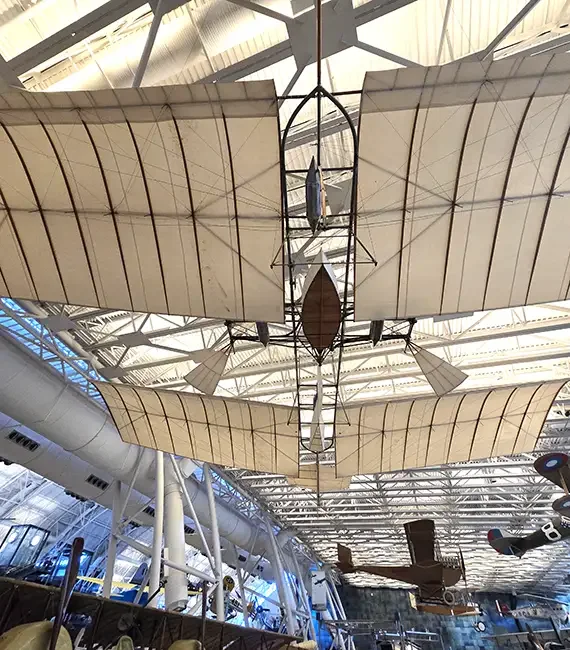
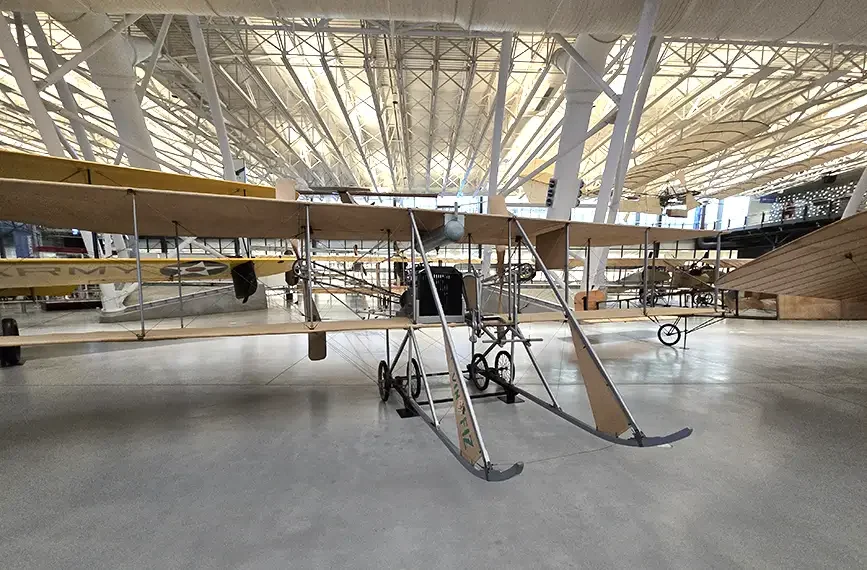
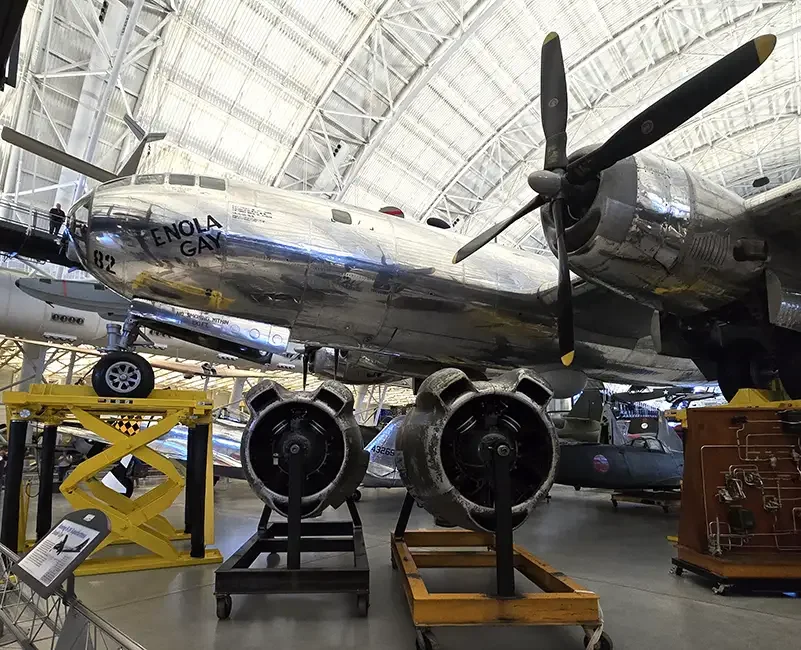
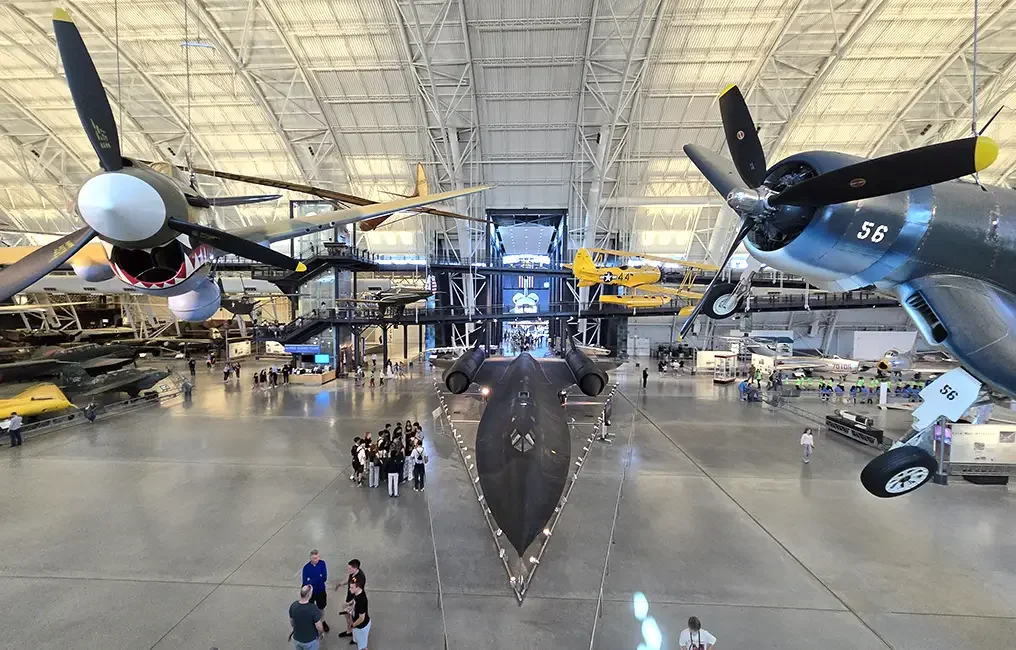
CLOCKWISE FROM TOP LEFT: The entrance hall of the National Air and Space Museum’s Steven F. Udvar‑Hazy Center; The Aerodrome‑A, one of the earliest flying machines, designed by physicist Samuel Langley in 1903 and launched from a houseboat on the Potomac — it never flew, and within days the Wright Brothers achieved their first successful flight; In 1910, daredevil pilot Cal Rodgers — described as the “Evel Knievel” of his era — bought a Wright Brothers plane in an attempt to win the $50,000 prize offered by William Randolph Hearst for flying across the U.S. within 30 days, but he never claimed the reward; The Enola Gay, a B‑29 bomber, dropped the first atomic bomb used in warfare on Hiroshima, Japan, in 1945.
The enormous hangar-style facility tells the story of flight in America, from the earliest experiments to modern space exploration. The museum houses both restored aircraft and preserved originals, the latter appearing much as they did after their final flights.
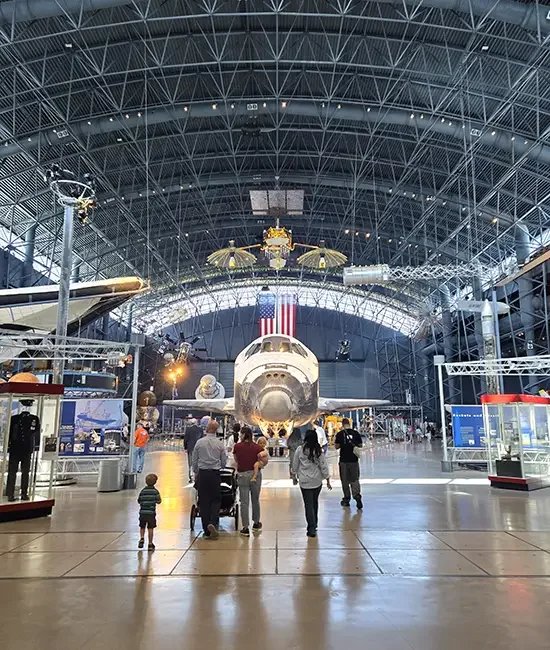
No matter your age, stepping into the museum sparks an almost childlike sense of awe. From the end of the towering entry hall, visitors catch their first glimpse of the immense aviation hangar. Suspended aircraft stretch into the distance, while the unmistakable engines of Space Shuttle Discovery are visible at the far end.
The museum buzzes with energy.
Volunteer docents — many of them retired engineers, pilots, and all aviation enthusiasts — guide free daily tours through the exhibits. Our docent, Ernie, brought the aircraft to life with stories that transformed static displays into living history.
It’s one thing to see the Wright brothers’ early flying machines; it’s another to hear the triumphs, failures, and strange stories behind them. Standing across the hangar from those fragile beginnings is Space Shuttle Discovery, the workhorse, or perhaps delivery van, of the American space program.
TIP: Upon arrival, check the Tour Desk near the entrance for free docent tour schedules and availability.
We also learned that NASA’s Artemis rockets incorporate many leftover shuttle components. Artemis II, which recently completed its mission around the Moon, even used parts originally built for Discovery.
In addition to the docents, “Blue Crew” volunteers help visitors navigate the museum, while “Red Shirts” stationed throughout the exhibits provide deeper explanations about specific artifacts.
Ernie recommends setting aside at least half a day to explore the museum, ideally beginning with a guided tour to help orient yourself. And despite the museum already feeling enormous, a planned expansion (scheduled to be completed in 2028) will increase the Boeing Aviation Hangar to nearly 75,000 square metres — roughly the size of 10 soccer fields under one roof.
Alongside approximately 200 aircraft and spacecraft, the museum also features simulators, a planetarium, and an IMAX theatre available for an additional fee. Thankfully, there’s even an on-site Shake Shack where visitors can refuel between exhibits.
Where to Stay



Photos: April Greer, ©Virginia Tourism CorporationWe arrived into Washington Dulles International Airport and chose to take the metro directly to the Hyatt Regency at Tysons Corner Center. Thanks to tap-on access at the airport and an elevated pedestrian walkway connecting the metro station and hotel, the transfer was easy and stress-free.
For travellers planning to explore Washington, D.C., the same subway line takes visitors directly to the National Mall and Smithsonian museums in about 20 minutes.
The hotel also connects directly to Tysons Corner Center, one of the largest shopping malls in the United States.
The Hyatt Regency feels polished and sophisticated while still maintaining a relaxed atmosphere. Part of that vibe comes from the open-air public plaza just off the lobby, as well as the Barrel & Bushel Restaurant and Bar, which spills out into the shared public space and seems to be a popular after-work gathering place for local professionals.
Virginia really is for History Lovers, and with the nation’s 250th anniversary, it is a special time to explore the state’s museums and historic sites.
After our time exploring Fairfax County, we headed south toward Jamestown, Williamsburg, and Yorktown for more history, then on to sandy beaches and ocean swims. Read all about that adventure here!
For more information on travel to Virginia, www.virginia.org

Header image: Sarah Hauser ©Virginia Tourism Corporation